Finding the correct mechanical seal is not always as simple as searching for a pump model or OEM part number. Industrial plants often operate pumps and rotating equipment that have been in service for many years, while the original seal may have been modified, discontinued or replaced several times.
In these situations, a custom mechanical seal can be manufactured according to the dimensions of the existing seal, technical drawing and actual operating conditions.
KE Motion Hydro manufactures mechanical seals and compatible replacement sealing solutions for industrial customers in the UAE, including Dubai, Abu Dhabi, Sharjah and other industrial locations.
Depending on the application, a mechanical seal can be identified using the pump model, OEM reference, technical drawing, dimensions or a sample of the existing seal.
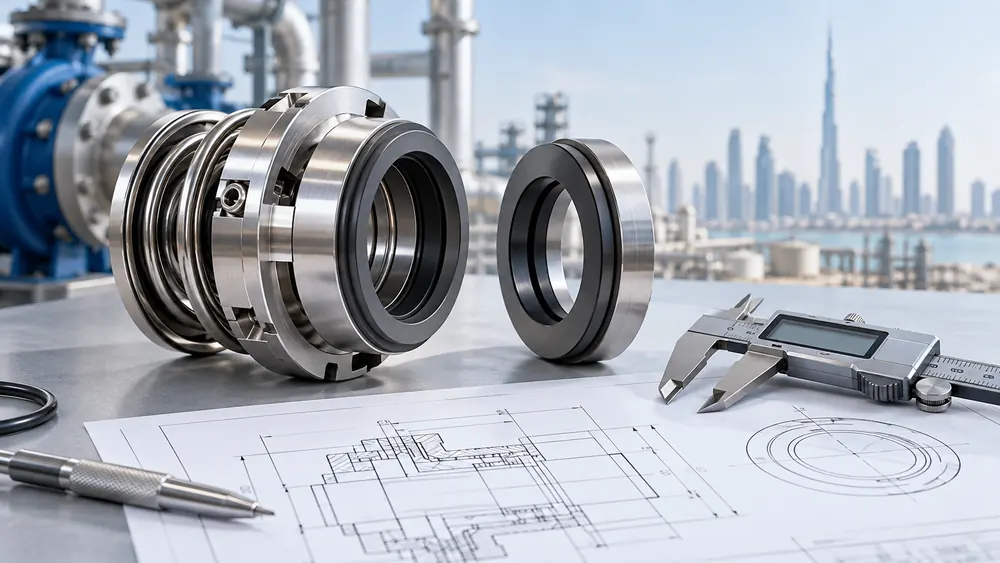
A custom-made mechanical seal can be required when a standard replacement cannot be identified or when the operating conditions require a different seal configuration or material combination.
Typical situations include:
In many cases, replacing an entire pump or modifying existing equipment is unnecessary. A correctly identified replacement mechanical seal can be manufactured to fit the existing installation.
The appropriate solution depends on how much information is available about the existing equipment.
A standard replacement is usually the best option when the existing pump and seal can be clearly identified.
Typical situations include:
In these cases, a replacement mechanical seal can usually be selected without the need for a completely custom design.
A custom-made mechanical seal may be required when identification is not possible or when the existing equipment uses non-standard dimensions or operating conditions.
Typical situations include:
When a standard equivalent cannot be identified, the mechanical seal can be evaluated based on its design, dimensions and operating parameters.
Accurate technical information is essential when manufacturing a custom mechanical seal.
The most important parameters are described below.
The shaft diameter is one of the primary dimensions used to identify and manufacture a mechanical seal.
This measurement needs to be accurate because the rotating seal components must fit correctly onto the pump shaft or shaft sleeve.
For an unknown mechanical seal, the shaft diameter is normally one of the first dimensions that should be provided.
Shaft diameter alone is not sufficient.
Depending on the seal design, additional dimensions may include:
A technical drawing with clearly marked dimensions is the preferred solution whenever available.
If a drawing does not exist, measurements and detailed photographs of the existing seal can often provide the information required for identification.
Mechanical seals can use different stationary seat configurations.
The seat should therefore be identified by:
Providing photographs of both the rotating and stationary parts can significantly simplify the identification process.
The liquid or process medium being sealed directly affects material selection.
Examples include:
A seal designed for clean water may not be suitable for a chemically aggressive liquid, abrasive wastewater or high-salinity application.
For this reason, the process medium should always be specified when requesting a custom mechanical seal.
Temperature affects both the seal faces and the elastomer components.
Applications operating at elevated temperatures may require different face materials, elastomers or even a different mechanical seal design.
The normal operating temperature and maximum expected temperature should therefore be provided whenever possible.
Seal chamber pressure is another important parameter.
Higher pressure can change the required seal design and determine whether a standard component seal, balanced seal or cartridge solution is appropriate.
When available, provide:
Shaft speed affects heat generation and the operating conditions at the seal faces.
For pumps, the speed is normally expressed in RPM — revolutions per minute.
Providing the motor speed or pump data plate can therefore help during mechanical seal selection.
The two seal faces are among the most important working components of a mechanical seal.
The correct material combination depends on the operating conditions and process medium.
Elastomers provide secondary sealing inside the mechanical seal.
The material must be compatible with the process medium and operating temperature.
In many cases, yes.
An existing mechanical seal can provide valuable information even when the manufacturer and part number are unknown.
For identification, we recommend providing photographs showing:
A physical sample or detailed technical drawing can provide additional information when the geometry cannot be determined reliably from photographs alone.
However, copying dimensions is only part of the process.
The actual operating conditions should also be confirmed so that the selected face and elastomer materials are appropriate for the application.
Custom mechanical seals UAE are used in a wide range of industrial applications and operating environments.
Depending on the industry, different seal designs and material combinations may be required.
Mechanical seals used with seawater, brine and water-treatment systems require careful selection of wetted materials and seal-face combinations.
High salinity and operating pressure can make material selection particularly important.
Large circulation pumps are used throughout district cooling and HVAC installations in Dubai, Abu Dhabi and other UAE cities.
Mechanical seals for these pumps are commonly required during scheduled maintenance and pump overhaul.
Process pumps can operate with hydrocarbons, chemicals, elevated temperatures and demanding pressure conditions.
For such applications, seal selection must be based on the complete process data rather than dimensions alone.
Pumps aboard vessels and in marine facilities can operate with seawater and other corrosive media.
Mechanical seals may be required for cooling-water pumps, ballast systems, utility pumps and other rotating equipment.
A custom seal is not necessary for every request.
KE Motion Hydro also manufactures compatible replacement mechanical seals for pumps and industrial equipment from various manufacturers.
When the pump manufacturer and model are known, the existing seal can often be identified from the equipment information.
Useful information includes:
For unidentified or modified equipment, dimensional identification can be used instead.
To prepare a mechanical seal quotation as accurately as possible, send the information available from the following list:
You do not necessarily need to have all of this information before contacting us.
If the mechanical seal can be identified from the pump model, part number or photographs, fewer measurements may be required.
KE Motion Hydro manufactures standard and custom mechanical seals for pumps and rotating industrial equipment.
Our product range includes component mechanical seals, rubber bellow seals, pusher seals, metal bellow designs, cartridge seals, mixer seals and other engineered sealing solutions.
For UAE customers requiring an existing seal replacement, we can evaluate the application using the OEM reference, pump information, technical drawing, dimensions or photographs of the existing mechanical seal.
For our broader range of solutions, visit our Mechanical Seals UAE page.
Contact our engineering team with your application data — media, temperature, pressure, speed, and machine type — for a technical recommendation and quotation.
Email: info@kemotionhydro.com | Phone: +381 (63) 451-842 | Web: kemotionhydro.com
